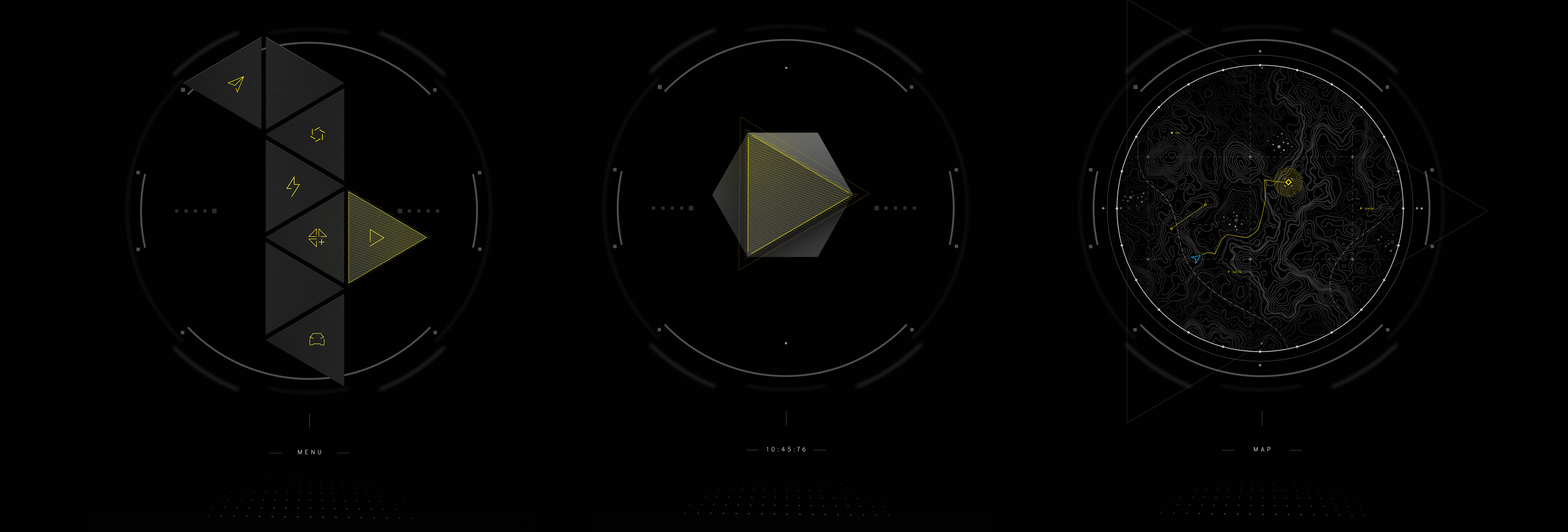
This project explored how augmented reality could be used within a future automotive interface while retaining elements of the brand’s existing visual language.
The brief was deliberately open, allowing us to look beyond current production technology and consider future projection systems, spatial displays and wearable devices.
One of the main concepts was a hexagonal menu system designed to work in three-dimensional space. Elements could move through depth, expand and unfold as the user interacted with them, allowing information and controls to be organised spatially rather than across conventional flat screens.
We also considered haptic feedback as a way of giving virtual interactions a more physical response.
I think this sort of work is great. The freedom of the brief allowed me to push ideas without being restricted by the limitations of current technology. It’s a mix of conceptual exploration, art and predicting future possibilities.
The brief was deliberately open, allowing us to look beyond current production technology and consider future projection systems, spatial displays and wearable devices.
One of the main concepts was a hexagonal menu system designed to work in three-dimensional space. Elements could move through depth, expand and unfold as the user interacted with them, allowing information and controls to be organised spatially rather than across conventional flat screens.
We also considered haptic feedback as a way of giving virtual interactions a more physical response.
I think this sort of work is great. The freedom of the brief allowed me to push ideas without being restricted by the limitations of current technology. It’s a mix of conceptual exploration, art and predicting future possibilities.