Dance Hero!? Yes, this was nearly a thing, even if it never made it out into the world. Around fifteen years have passed and Activision is now part of Microsoft, so it feels safe to share a little context around this unreleased work.
The project emerged shortly after DJ Hero 2. Guitar Hero: Warriors of Rock had underperformed, leading Activision to expect DJ Hero 2 to follow a similar path and shift much of its marketing focus towards that year’s Call of Duty release. In reality, DJ Hero 2 reviewed well and sold around 1.2 million copies despite limited support, but Activision was chasing much bigger hits. Early pre-production on DJ Hero 3 explored dance as an extension of the franchise before evolving into a broader, music-led concept that became Dance Hero.
The project emerged shortly after DJ Hero 2. Guitar Hero: Warriors of Rock had underperformed, leading Activision to expect DJ Hero 2 to follow a similar path and shift much of its marketing focus towards that year’s Call of Duty release. In reality, DJ Hero 2 reviewed well and sold around 1.2 million copies despite limited support, but Activision was chasing much bigger hits. Early pre-production on DJ Hero 3 explored dance as an extension of the franchise before evolving into a broader, music-led concept that became Dance Hero.

The work shown here comes from an early vertical slice. I led the UI team and was responsible for defining the project’s overall tone and creative direction. I built a small, highly specialised team covering UI design, motion graphics and technical implementation, which allowed us to move quickly and explore ideas in depth.

Creatively, I wanted to take a very different approach from existing dance games such as Just Dance. Rather than broad family entertainment, the aim was to create something sharper and more contemporary, rooted in pop culture. Inspiration came from modern music videos and European music channels that were gaining attention at the time, particularly their bold idents, graphic overlays and confident on-screen typography.

By comparison, Just Dance had something closer to an Asda advert or daytime-radio aesthetic. That is not necessarily a criticism. Its deliberately broad, family-friendly approach was enormously successful. Dance Hero was intended to occupy different territory, with a cooler and more pop-driven identity.

From a design and presentation perspective, I was particularly interested in the relationship between strong graphic design and 3D form. The aim was to build on what already worked within the genre while giving it a more modern, visually confident attitude.
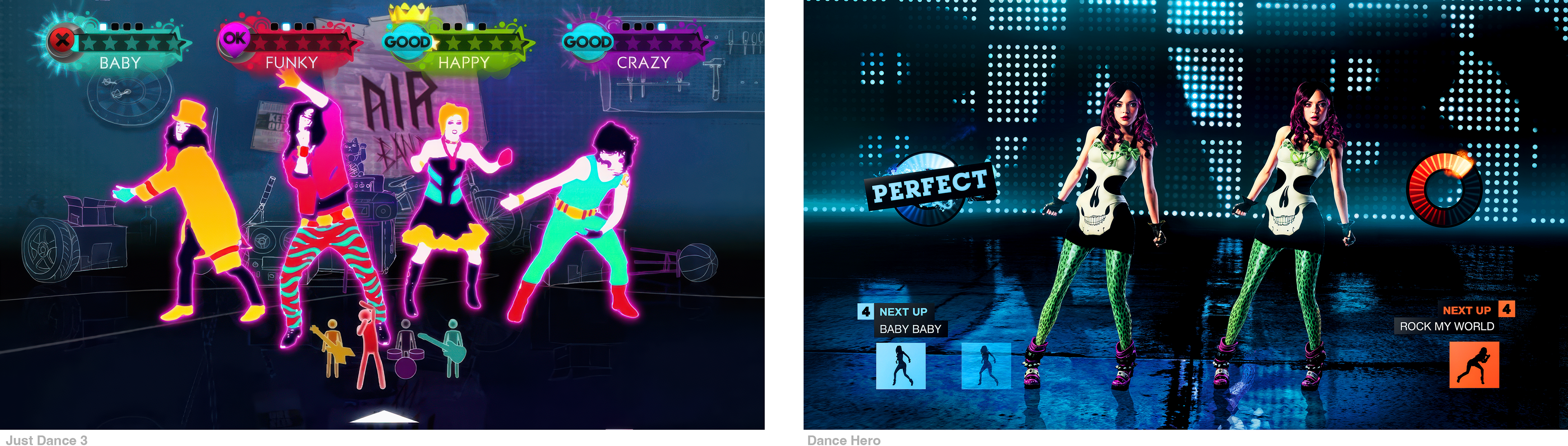
When viewed side by side, the difference in intent was clear. I leaned heavily into music-video language, dynamic camera movement and visual references drawn from artists such as Beyoncé and Katy Perry. Taking ideas from adjacent media and translating them into interactive experiences was an approach I had carried over from my earlier work in advertising.
This direction extended into the front end, where real-time music-video sequences played in the background behind bold, clean and highly legible UI. Around the same period, Kinect-focused games were experimenting with arm movements as a method of navigating menus. We explored some of those ideas, although I was never entirely convinced that waving your arms around made for a better interface.
Ultimately, Dance Hero was cancelled before entering full production, and I later moved on to develop Sing Party with Nintendo. Although it never shipped, it was a strong creative exploration produced with a talented team, and one that I believe could have brought a more contemporary and visually confident identity to the dance-game genre.
This direction extended into the front end, where real-time music-video sequences played in the background behind bold, clean and highly legible UI. Around the same period, Kinect-focused games were experimenting with arm movements as a method of navigating menus. We explored some of those ideas, although I was never entirely convinced that waving your arms around made for a better interface.
Ultimately, Dance Hero was cancelled before entering full production, and I later moved on to develop Sing Party with Nintendo. Although it never shipped, it was a strong creative exploration produced with a talented team, and one that I believe could have brought a more contemporary and visually confident identity to the dance-game genre.