It’s time to get back to blue skies, speed, and adrenaline-fuelled action racers.
I enjoy realistic racers and open worlds as much as anyone, but somewhere along the line the balance has shifted. In that shift, some of the core elements that made arcade racers so compelling have faded.
Games like OutRun, Hang-On, Daytona USA and Ridge Racer were an assault on the senses. You didn’t just see them, you felt them and often heard them from across the arcade. Immediate, readable, instantly playable. Simple on the surface, easy to play, hard to master, with iconic visuals. That’s why they still hold up.
The Burnout series built on that foundation and pushed it further, adding scale and spectacle for a maturing console market in the 00s.
Buggy Burn comes from that lineage. It builds on sketches I made over 20 years ago, now brought to life with modern tools.
It’s not about nostalgia. It’s about reconnecting with what made these games work, seeing how that fits today, and maybe bringing a bit more diversity back into the racing genre.
I enjoy realistic racers and open worlds as much as anyone, but somewhere along the line the balance has shifted. In that shift, some of the core elements that made arcade racers so compelling have faded.
Games like OutRun, Hang-On, Daytona USA and Ridge Racer were an assault on the senses. You didn’t just see them, you felt them and often heard them from across the arcade. Immediate, readable, instantly playable. Simple on the surface, easy to play, hard to master, with iconic visuals. That’s why they still hold up.
The Burnout series built on that foundation and pushed it further, adding scale and spectacle for a maturing console market in the 00s.
Buggy Burn comes from that lineage. It builds on sketches I made over 20 years ago, now brought to life with modern tools.
It’s not about nostalgia. It’s about reconnecting with what made these games work, seeing how that fits today, and maybe bringing a bit more diversity back into the racing genre.

Buggy Burn (working title)
This is basically the kind of game I feel is missing, and one I want to make and play.
Games should ignite your imagination. First for yourself, then for the player. If I don’t think something is cool, it’s dead on arrival.
As budgets have grown, checklists and conformity have followed. Not every game needs to be a AAA 30-hour experience. A run on Super Hang-On lasts a few minutes, but I’ll always go back to it. Longevity and fun matter as much as hours played.
Buggy Burn is an arcade racer built for modern hardware. It’s about speed, flow and clarity. Fast, responsive, precise controls. 60 FPS or above is non-negotiable.
The world is hyper-real. Based on real places, but exaggerated and remixed to make them memorable. Bright, clean art direction with strong environmental effects. The vehicle is deliberately iconic, inspired by the classic Volkswagen beach buggy. Big, bold and orange.
Tracks are linear and looping. Easy to learn, hard to master. Memorable corners matter. Jumps, sand and road sections keep things moving, but never get in the way. This is about fun, not simulation.
This isn’t retro nostalgia. It’s taking what worked, combining it with modern standards, and bringing something back that’s been missing.
This is basically the kind of game I feel is missing, and one I want to make and play.
Games should ignite your imagination. First for yourself, then for the player. If I don’t think something is cool, it’s dead on arrival.
As budgets have grown, checklists and conformity have followed. Not every game needs to be a AAA 30-hour experience. A run on Super Hang-On lasts a few minutes, but I’ll always go back to it. Longevity and fun matter as much as hours played.
Buggy Burn is an arcade racer built for modern hardware. It’s about speed, flow and clarity. Fast, responsive, precise controls. 60 FPS or above is non-negotiable.
The world is hyper-real. Based on real places, but exaggerated and remixed to make them memorable. Bright, clean art direction with strong environmental effects. The vehicle is deliberately iconic, inspired by the classic Volkswagen beach buggy. Big, bold and orange.
Tracks are linear and looping. Easy to learn, hard to master. Memorable corners matter. Jumps, sand and road sections keep things moving, but never get in the way. This is about fun, not simulation.
This isn’t retro nostalgia. It’s taking what worked, combining it with modern standards, and bringing something back that’s been missing.

Original sketch from around 20 years ago, based on photography I took at Porthmeor Beach in St Ives. I pushed it towards an American beach look with huts to give it a more universal, iconic feel, closer to something like Baywatch.
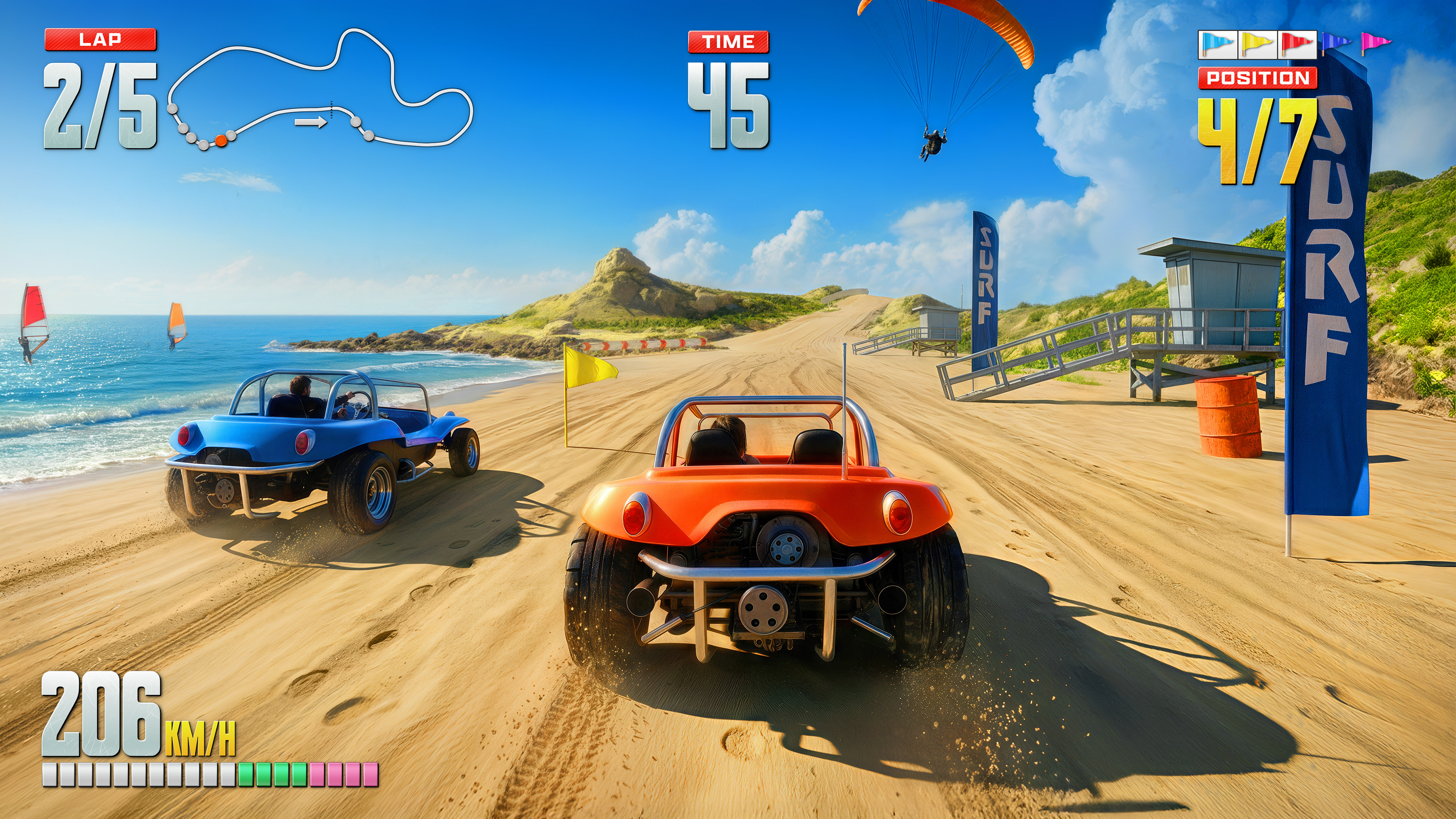
Concept produced in 2026 using modern techniques.
Creating a small animatic is a fast way to establish direction for a new IP. It’s not the full vision, just a way to set tone and move things forward.
I’ve done this since my Activision days. Static key art never quite captured what we were trying to build. Back in the 00s this would take weeks and a small team of specialists.
Now you can move much faster with AI. It’s still rough in places, but that’s fine. Like any tool, it comes down to direction. The important part is staying in control of it.
The process is simple. Start with a sketch, use AI to build a rough visual, then manually refine it. Layer in UI and HUD.
I’ve done this since my Activision days. Static key art never quite captured what we were trying to build. Back in the 00s this would take weeks and a small team of specialists.
Now you can move much faster with AI. It’s still rough in places, but that’s fine. Like any tool, it comes down to direction. The important part is staying in control of it.
The process is simple. Start with a sketch, use AI to build a rough visual, then manually refine it. Layer in UI and HUD.

The HUD was a chance to push against the current trend.
Modern UI has gone very clinical and stripped back. I like that, we pushed for it in the 00s, but it’s become the default and it’s a bit bland now.
Arcade racers should have personality. Older games were bold, colourful and unapologetically gamey. So I leaned into that, shiny metal fonts, strong presence.
It’s heavily inspired by OutRun and Buggy Boy. And yes, the speedometer is basically lifted from OutRun. It works.
Modern UI has gone very clinical and stripped back. I like that, we pushed for it in the 00s, but it’s become the default and it’s a bit bland now.
Arcade racers should have personality. Older games were bold, colourful and unapologetically gamey. So I leaned into that, shiny metal fonts, strong presence.
It’s heavily inspired by OutRun and Buggy Boy. And yes, the speedometer is basically lifted from OutRun. It works.
This was just a bit of fun. A front-end intro inspired by the GameCube era, 1080° Avalanche, Wave Race: Blue Storm. They weren’t just menus. They set the tone and carried that arcade energy. A modern version of an attract mode.

Original buggy sketches from around 20 years ago. I even bought a VW buggy book to keep it vaguely grounded. Looking at them now, I’d probably modernise the front a bit, but they still do the job.
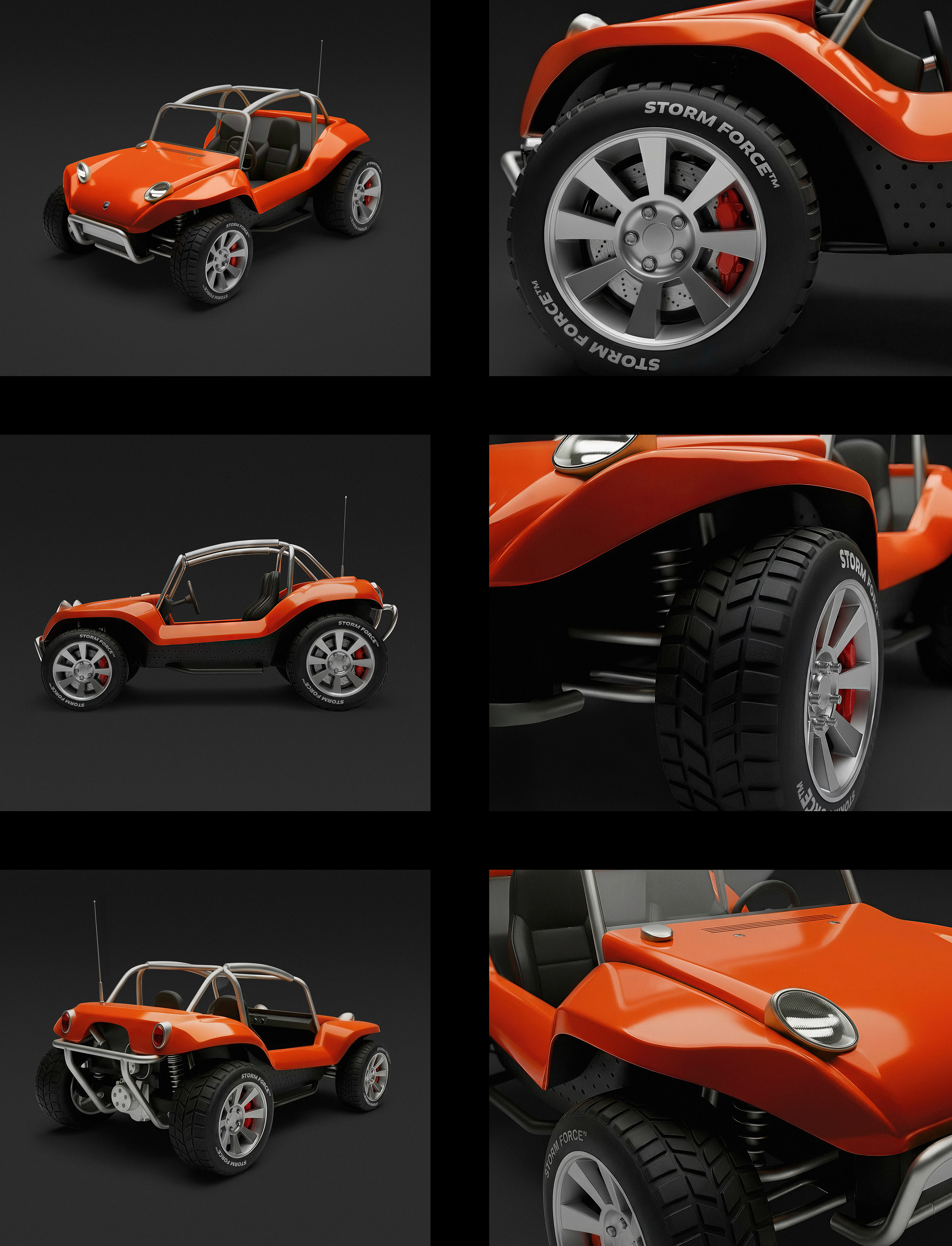
After the animations, I wanted to push the original sketches further.
Using AI alongside a heavy dose of traditional artworking, I started defining the vehicle properly. Taking something rough from 20 years ago and bringing it up to a usable level.
It’s not perfect, but it shows what’s possible with solid direction and how quickly you can get there now.
Using AI alongside a heavy dose of traditional artworking, I started defining the vehicle properly. Taking something rough from 20 years ago and bringing it up to a usable level.
It’s not perfect, but it shows what’s possible with solid direction and how quickly you can get there now.
And finally, just for a bit of fun, I put together a sit-down arcade cabinet.
I’ve always loved the original OutRun cabinet, the booming audio and physical movement. I was lucky enough to play one recently, and it still holds up. Still a great experience.
I’ve always loved the original OutRun cabinet, the booming audio and physical movement. I was lucky enough to play one recently, and it still holds up. Still a great experience.